


Real estate can play a meaningful role in a private equity buyout. When an M&A target owns some or all of its operational real estate, in many cases, those properties can be monetized with the capital reallocated through a sale leaseback to fund a portion of the acquisition.
While conceptually this is simple, we have found there are misconceptions about the use of sale leasebacks in buyouts and the advantages SLBs confer upon PE sponsors.
Misconception #1: We should only pursue a sale leaseback when the proceeds are a sizeable portion of the total deal size.
The top-level answer is that while a sale leaseback might not make sense to run concurrently if it’s a minuscule proportion of aggregate value, a lower bound of say 10%-15% is where many of our sponsor clients find that SLBs start to make a lot of sense.
Private equity firms are reluctant to commit to a sale leaseback process because it may detract management attention from the larger and more important M&A transaction. In a complex and quickly moving transaction where the sponsor is managing multiple work streams, it may seem that a smaller portion of the capital stack may not be material enough to commit to an entirely separate process.
This is where a sale leaseback advisor comes in. They can take on not just the broad marketing process but also, post-LOI, facilitate due diligence, lease negotiations and focus on the end goal of the overall M&A transaction. Overall, they can significantly reduce the threshold where the sale leaseback is value accretive for the overall transaction.
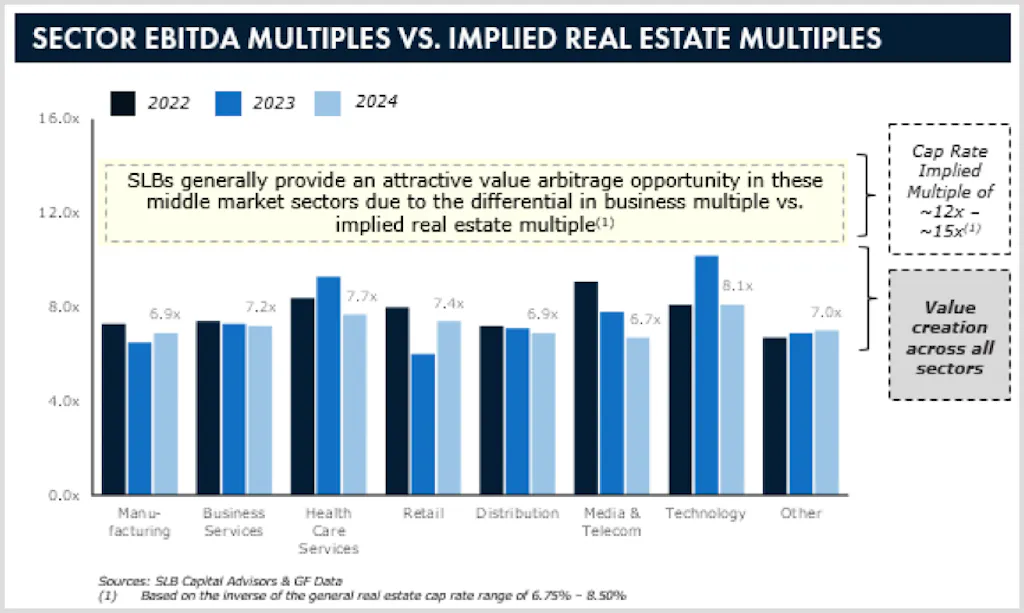
Importantly, regardless of size, the gap between business EBITDA multiples and implied real estate multiples (as shown in the chart below) creates a compelling arbitrage opportunity across sectors, which can only be unlocked through a sale leaseback.
Misconception #2: A sale leaseback will limit our ability to sell the company down the road.
Sponsors are, and rightfully should be, hyper-focused on the freedom to exit the business without other constituencies creating a ‘tail wagging the dog’ scenario. In particular, for operators with multiple locations where a subset of the properties is monetized through a sale leaseback, the prospect of a new landlord having veto power over a broader transaction may dissuade consideration of a sale leaseback in the first place. Understandably, landlords are committing to the sale leaseback under certain credit conditions, and they will seek protections against real or perceived deterioration of the credit. However, having an advisor with an understanding of both the landlord and the sponsor’s interests can help bridge that gap, reducing endless turns of legal docs.
While change of control issues cannot be eliminated, they can be substantially de-risked by stipulating conditions under which the sponsor can assign the lease without landlord consent. These conditions can be negotiated during the marketing process, led by the advisor, to reasonably cover the scenarios under which the sponsor would seek a change of control.
Misconception #3: A sale leaseback will hold up the completion of the buyout.
Net, net, the real estate transaction is simpler than the buyout. A good advisor will run the transaction and structure a timeline that is predicated on the buyout’s closing date. Often the sale leaseback investor is ready to go to the closing table, while the timeline on the buyout slips. This generally has no impact on the buyer’s desire to own the real estate, but rather means that when the buyout is truly at hand, the real estate investors are ready to go on a moment’s notice.
Misconception #4: We should wait until interest rates go down before doing a sale leaseback.
Post Great Recession through 2022, commercial property owners could count on cap rate compression to create value. Since then, this strategy has proven to be the undoing of many a real estate investor. The idea of capital allocation by an OPCO predicated on cap rate compression, and based on interest rates declining, is a strategy better left for real estate investors to pursue. For sponsors, determining the optimal use of capital tied up in real estate, not interest rate fluctuations, should be driving the conversation.
Misconception #5: Real estate is a sideshow to our primary mission of buying and exiting companies and earning a return for our investors.
We believe there are very few reasons for OPCO private equity investors to own real estate. Most sponsors attract investors by delivering IRRs north of 20%. Having equity capital tied up in real estate generally presents a headwind to achieving that objective, since owned real property is most typically a low-return asset. Mathematically and in practical terms, hitting the return sponsors are aiming for necessitates shedding assets with lower returns, and these assets can be efficiently shed through the sale leaseback process.
The original version of this article appeared in The Earnout magazine.